
Building a backyard deck feels straightforward until the invoices start arriving. Most homeowners budget for lumber and labor, then discover a string of expenses they never saw coming — permits, footings, finishing coats, and more. These overlooked costs don’t just nudge a project slightly over budget; they can add 30 to 50 percent to the original estimate. Understanding where that gap comes from, before construction starts, is the difference between a deck that gets built and one that stalls halfway through because the money ran out.
Permits, Inspections, and the Paperwork Nobody Plans For
Deck permits are among the most consistently underestimated costs in residential construction. Most jurisdictions require a building permit for any attached deck or any freestanding structure above a certain height — typically 30 inches off the ground — and fees vary widely. A modest deck project might require $150 in permits in one county and over $1,200 in another, depending on the square footage assessed and the local fee schedule.
What catches homeowners off guard isn’t just the permit fee itself. It’s the inspection timeline. Most jurisdictions require at least two inspections: one after the footings are poured and one after framing is complete. If an inspector flags a problem, work stops until it’s corrected and re-inspected. That delay can add days or weeks to the project, which translates directly into extended labor costs if a contractor is billing hourly or has other jobs queued.
There’s also an insurance angle worth taking seriously. Decks built without permits may not be covered by homeowner’s insurance if they’re damaged or cause injury. And when the house eventually sells, an unpermitted deck can complicate or delay closing. The permit cost, however annoying, is doing more work than most people realize.
- Contact the local building department at least 3 weeks before construction starts to confirm permit requirements and current fee schedules.
- Ask the contractor whether the permit application fee is included in their quote or billed as a separate line item.
- Budget a contingency of $300 to $500 specifically for re-inspection fees if corrections are required.
Footings, Ledger Attachments, and What Lies Beneath
The framing that’s visible isn’t where the money quietly disappears — it’s what’s underground. Concrete footings anchor the deck’s posts and must extend below the frost line, which varies by region and can be anywhere from 12 to 48 inches deep. Digging and pouring those footings adds cost that rarely appears in the headline estimate a contractor gives at the first meeting.
The ledger board — the piece that connects an attached deck to the house — is another source of hidden expense. If the house has old siding, rotted sheathing, or inadequate flashing behind it, those issues must be fixed before the ledger can be properly installed. A homeowner who assumed the ledger connection was a minor detail has discovered, mid-project, that repairing the underlying wall cost an additional $800 to $2,000.
Soil conditions add another layer of uncertainty. Rocky ground, high water tables, or unstable fill soil can require engineered footings rather than standard tube forms. That change alone can push footing costs from $400 to well over $1,500 depending on the number of posts and the engineering required.
The honest question to ask any contractor before signing is: “What happens if the footings hit rock or water?” If the answer is vague, get it in writing as a contingency clause with a clear cost structure before work begins.
Decking Materials, Fasteners, and the True Cost of Finishing
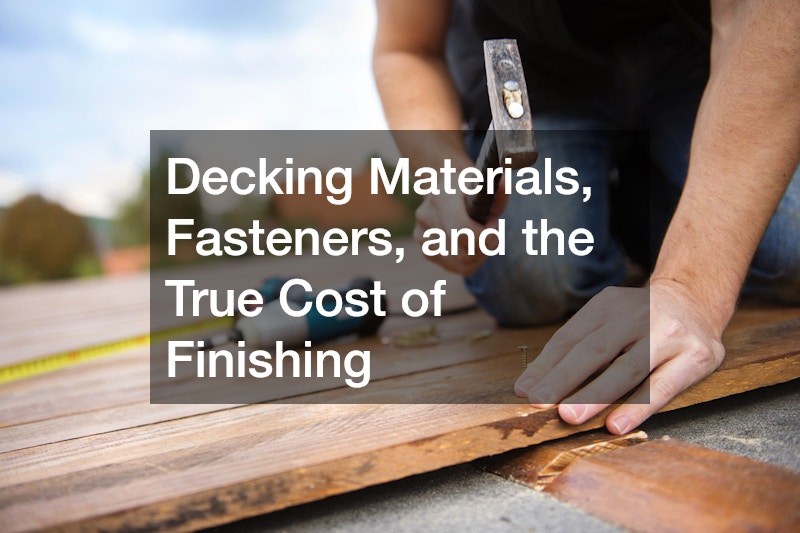
Most budget conversations focus on the decking boards — but the boards are only part of what gets purchased. Fasteners, joist hangers, post caps, and hardware materials together represent a substantial portion of material costs that often get lumped into vague line items or skipped in early estimates entirely.
Composite decking is the clearest example of where material costs diverge from expectations. A homeowner who chose composite boards over pressure-treated lumber to avoid maintenance costs paid roughly $38 to $45 per square foot installed, compared to $15 to $25 for basic pressure-treated wood. The lower maintenance is real, but the upfront gap surprises people who only saw the per-board price at the supply yard.
Finishing costs add another layer. Pressure-treated wood decks almost always require staining or sealing within the first year of installation, once the wood has dried sufficiently. That means a return visit from a contractor — or a weekend of DIY labor — plus the cost of a quality penetrating sealer, which runs $30 to $60 per gallon and typically covers 200 to 300 square feet per coat. A 400-square-foot deck needs two coats, which adds up faster than the original lumber price suggests.
- When reviewing a contractor quote, ask for the fastener and hardware line to be broken out separately rather than bundled into a general materials estimate.
- If choosing composite decking, compare at least 3 products by warranty length (25-year vs. lifetime) rather than price alone — warranty terms differ significantly on fading and staining coverage.
- Budget $1.50 to $2.00 per square foot for a first-year sealing application on pressure-treated lumber, separate from the build cost.
Railings, Stairs, Lighting, and the Extras That Aren’t Optional
Railings are non-negotiable on any deck surface more than 30 inches above grade — code requires them, and they represent a cost that’s easy to dismiss in early planning because they feel like an accessory. They’re not. Railing systems for a modest 12-by-16-foot deck can run $1,500 to $4,000 depending on material choice. Wood balusters are cheapest; cable railing and glass panel systems sit at the high end, but both add a disproportionate amount to the total project cost relative to the square footage they cover.
Stairs get underestimated in a similar way. Each step requires stringers, treads, risers, and often handrails on both sides if the stair width exceeds 44 inches. A single stair run from deck level to grade can cost $400 to $900 installed — more if it includes a landing at the bottom.
Lighting and electrical work rarely appear in the initial conversation but surface quickly once the deck is framed and someone realizes there’s no way to use it after dark. Low-voltage deck lighting kits start around $150 for basic post cap and step lights. A hardwired setup with a dedicated outdoor circuit from the panel adds $300 to $800 in electrical work, not including fixtures.
The pattern across all of these items is the same: each one feels minor individually, and collectively they can add $5,000 to $10,000 to a project that was budgeted as a simpler build.
Building a Realistic Deck Budget Before Breaking Ground
The most useful step any homeowner can take is separating the deck into five cost categories before getting a single contractor quote: structure and footings, decking surface and fasteners, railings and stairs, finishing and weatherproofing, and permits and inspections. Pricing each category independently — even roughly — forces the planning conversation to surface the expenses that typically disappear into a single round-number estimate. It also makes contractor bids easier to compare, because a quote that excludes permits or finishing is immediately visible rather than buried. Add a 15 percent contingency across the full project total, not just materials, because labor overruns and unforeseen structural issues follow the same pattern regardless of how carefully the initial plan was drawn.