
A serious diagnosis — whether a spinal cord injury, stroke, progressive neurological condition, or major amputation — doesn’t just change how a person moves through the world. It dismantles the invisible architecture of daily life: the routines, habits, and small freedoms most people never think to count. Rebuilding that independence isn’t about returning to what was. It’s about constructing something functional and sustainable from wherever you are now. That process is rarely linear, and it rarely happens on the timeline anyone expects.
Rethinking What Independence Actually Means
The first mistake many people make after a major diagnosis is treating independence as an all-or-nothing condition — either fully capable or fully dependent. That framing becomes a barrier. Functional independence is better understood as the ability to direct your own life, even when specific tasks require tools, adaptations, or assistance.
Occupational therapists use a concept called functional capacity evaluation to measure not what a person can’t do, but what they can do safely and consistently. This matters because it shifts the focus toward building on real strengths rather than cataloging losses. A person who needs assistance with bathing but can manage meal preparation, communication, and financial decisions independently is not living a diminished life — they’ve redistributed the load.
The trade-off worth considering early: how much energy should go toward recovering lost function versus adapting your environment and routines to match current capacity? Recovery therapy and environmental adaptation aren’t mutually exclusive, but time and energy are finite. For someone with a degenerative condition, pouring resources exclusively into recovery may produce diminishing returns compared to building adaptive systems now. For someone in acute recovery from a stroke, the equation looks different — neuroplasticity makes early intervention genuinely valuable.
Practical starting points worth acting on early:
- Schedule a comprehensive occupational therapy assessment within the first 60 days of diagnosis or discharge, specifically requesting a home environment evaluation alongside a functional capacity review.
- Keep a two-week log of which daily tasks consume disproportionate energy or trigger pain — this data makes therapy sessions more targeted and efficient.
- Separate tasks by cognitive load versus physical load; both fatigue independently and require different adaptive strategies.
Adapting the Home Before Problems Force the Decision
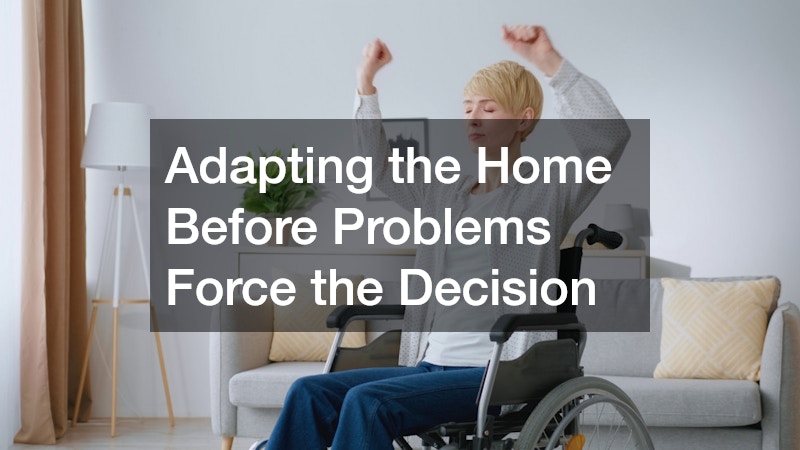
Most people wait until a fall, a hospitalization, or a visible safety failure before modifying their living space. By that point, the adaptation is reactive — rushed, underfunded, and often poorly planned. The home environment is one of the highest-leverage areas for rebuilding daily independence, and it rewards early, deliberate attention.
The scope of necessary modification varies enormously by diagnosis. A person managing post-surgical mobility restrictions may need only temporary grab bars and a shower chair. Someone with a progressive condition like multiple sclerosis or ALS needs to think in phases — what works at current function levels and what can be upgraded without a full renovation when mobility changes further. Building in that flexibility upfront costs less than retrofitting later.
Bathroom modifications consistently produce the highest return on independence per dollar spent. A roll-in shower with a fold-down seat, lever-style faucet handles, and grab bars installed into wall studs (not just drywall) can prevent falls that lead to hospitalizations costing tens of thousands of dollars. Doorway widening to 36 inches — the standard for wheelchair access — is worth considering even for people currently ambulatory with a progressive diagnosis.
The financial reality: federal and some state programs, including Medicaid waiver programs and the USDA Rural Development program, offer grants or low-interest loans for home modifications. Veterans may access separate funding through the VA’s Specially Adapted Housing grant, which covers up to $109,986 for qualifying conditions as of 2024. These programs require lead time to apply — another reason not to wait for a crisis.
Transportation and Getting Back Into the World
Loss of driving ability or comfortable transit access isolates people faster than almost any other consequence of a serious diagnosis. Social isolation, in turn, accelerates cognitive and physical decline — a well-documented feedback loop that makes transportation planning a health decision, not just a logistics one.
The options range considerably in cost and control. Paratransit services, required under the Americans with Disabilities Act for qualifying individuals, provide scheduled rides within a fixed radius of fixed-route transit. They’re low-cost but inflexible — trips require advance booking, often 24 hours ahead, and cancellations are common. Rideshare accessibility features vary by market and vehicle availability. Neither option restores the spontaneity that makes daily independence feel real.
For people who want to resume driving, adaptive driving programs — offered through rehabilitation hospitals and some occupational therapy practices — assess current capacity and match it to appropriate vehicle modifications. Hand controls, spinner knobs, and pedal extensions are covered by some insurance policies under durable medical equipment categories. For passengers who cannot transfer easily, a wheelchair accessible van eliminates the need for a difficult transfer entirely, keeping a power wheelchair or scooter secured in place during travel.
The comparison worth making honestly: modified personal vehicle versus paratransit versus rideshare. Modified personal driving or passenger transport costs more upfront — adaptive equipment runs from $1,000 for basic hand controls to $20,000 or more for full lift systems — but restores on-demand movement that paratransit simply cannot replicate. For someone managing work, medical appointments, and caregiving responsibilities, the scheduling flexibility alone often justifies the investment.
Managing Energy, Cognition, and the Invisible Symptoms
Many of the most disabling aspects of a serious diagnosis are invisible to others: fatigue that isn’t fixed by rest, cognitive fog, chronic pain, and emotional dysregulation. These symptoms disrupt independence as effectively as physical limitations, yet they’re frequently undertreated because they’re harder to quantify and easier for both patients and providers to dismiss.
Energy conservation isn’t passivity — it’s resource management. Pacing techniques developed in rehabilitation medicine, including activity scheduling and effort monitoring, help people distribute energy across a day without hitting a hard crash that wipes out the next 24 hours. Someone managing post-COVID fatigue syndrome or a traumatic brain injury may need to cap high-effort activities at 30-minute intervals before rest, at least in early recovery phases.
Cognitive tools deserve the same seriousness as physical aids:
- Use a single digital calendar system — not multiple apps — synced across devices, with 15-minute buffer reminders before appointments to account for slower preparation time.
- Create a laminated daily routine card for high-fatigue days when working memory drops; keep it in one fixed location, not stored digitally where it requires navigation.
- Track medication timing with a pill organizer divided by day and time of day, not just day — missed or doubled doses are a common and preventable complication during high-symptom periods.
The mental health dimension is inseparable from function. Depression and anxiety are clinical complications of many diagnoses, not just emotional responses to them. Both are treatable, and both, when undertreated, directly reduce participation in rehabilitation, social engagement, and self-care. Treating mood disorders as a medical priority — not a secondary concern — consistently improves functional outcomes.
Choosing the Right Pace for Long-Term Progress
Rebuilding independence after a serious diagnosis is not a project with a fixed completion date. It’s an ongoing process of reassessment — as function changes, as technology evolves, as life circumstances shift. The most sustainable approach acknowledges that some weeks will require pulling back, and that pulling back is not failure.
Set a formal review point every six months to reassess which adaptive tools still fit, which therapy goals remain relevant, and which home modifications should be added or updated. Independence isn’t reclaimed in one decision — it’s rebuilt in the accumulated weight of smaller, well-timed ones.