
Most rooms don’t get enough natural light to sustain the plants people actually want. North-facing windows, interior hallways, apartments hemmed in by taller buildings — these are real, common conditions, and they eliminate most of what’s sold at garden centers. The result is a cycle: buy a plant, watch it slowly collapse over six weeks, assume the problem is a lack of skill. Often the problem is simpler. The wrong plant was chosen for the space. Understanding which species genuinely tolerate dim conditions — and what “low light” actually means in practice — changes the outcome before a single pot is purchased.
What “Low Light” Actually Means (And Why It’s Usually Misread)
The phrase gets used loosely, which causes most of the early mistakes. In horticultural terms, low light means indirect ambient light with no direct sun exposure — typically around 25 to 50 foot-candles of illumination. That’s enough to read comfortably, but not enough to cast a sharp shadow. It is not darkness. Truly dark rooms — interior bathrooms without windows, closets, basement spaces with no natural source — cannot sustain live plants regardless of species. No plant photosynthesize effectively at zero light.
The practical test: hold your hand about a foot above a white sheet of paper in the space. A sharp, well-defined shadow means moderate light. A faint, soft shadow indicates low light. No shadow at all means the room is too dark for any plant to survive long-term without supplemental grow lighting.
Growers and gardeners often conflate “shade tolerant” with “low light tolerant,” but these aren’t identical categories. A shade-tolerant plant does well under a tree canopy — that’s still outdoor light, which can reach 1,000 foot-candles even in dappled conditions. True low-light tolerance is a narrower trait, and the species that possess it have evolved in genuinely dim forest understories.
One practical consequence: even genuinely low-light plants will benefit from being positioned as close to the light source as the room allows. A pothos placed six feet from a north window will perform meaningfully better than one placed twelve feet away. Distance from the window matters more than window orientation in many cases.
Species That Reliably Perform in Dim Conditions
A handful of plants have earned their reputation through consistent performance across a wide range of interior conditions, not just in ideal nursery settings.
Pothos (Epipremnum aureum) remains the benchmark for a reason. It tolerates irregular watering, low humidity, and genuinely dim rooms, and signals stress clearly — yellowing leaves typically mean overwatering, not underwatering — making it forgiving for less experienced growers. Golden pothos and marble queen varieties are the most adaptable.
ZZ plant (Zamioculcas zamiifolia) is arguably the most resilient option for truly challenging spaces. Its rhizomes store water, meaning it can survive weeks of neglect. Growth is slow under low light, but it rarely declines visibly. A ZZ plant in a dim office corner will hold its form for months without intervention.
Snake plant (Sansevieria, now reclassified as Dracaena trifasciata) handles low light and dry air simultaneously, which makes it particularly suitable for heated interiors during winter. It’s also one of the few low-light species that tolerates direct sun if conditions change — useful for renters whose light exposure shifts seasonally.
Cast iron plant (Aspidistra elatior) earns its name. It was a staple of Victorian-era parlors precisely because gas lighting and coal fires created difficult growing conditions indoors, and it survived both. It grows extremely slowly but maintains its appearance in rooms that would eliminate most alternatives.
For those who want something with more visual personality, heartleaf philodendron and peace lily (Spathiphyllum) both perform well in low light, though peace lily will flower far less — or not at all — without brighter conditions.
Watering and Care in Low-Light Environments
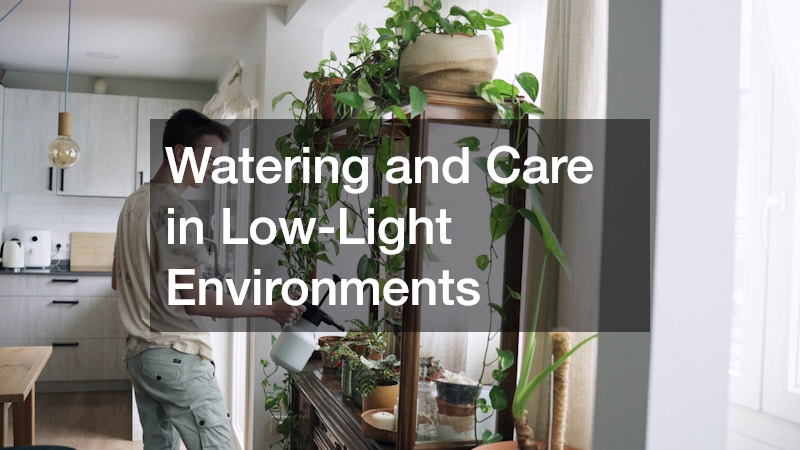
Here’s where many growers go wrong even after choosing the right plant: they continue caring for it as though it’s in a sunlit room. Plants in low light photosynthesize more slowly, which means they consume water and nutrients at a reduced rate. The soil stays wet longer. Overwatering becomes a genuine risk even with reasonable watering intervals.
A reliable rule for low-light species: water when the top two inches of soil are dry, not on a fixed weekly schedule. For ZZ plants and cast iron plants, allow the soil to dry almost completely before watering again. Frequency will likely drop to once every 10 to 14 days in winter for most low-light varieties.
Fertilizer use should also be reduced. Most low-light plants need feeding only during the active growing season — roughly March through September — and at half the concentration recommended on the label. Fertilizing a slow-growing plant in winter in dim conditions creates salt buildup in the soil without delivering any growth benefit.
The choice between terracotta and plastic or glazed pots is worth considering seriously here. Terracotta is porous and wicks moisture away from the root zone faster, which suits high-light, fast-growing plants. For low-light conditions where soil already dries slowly, a plastic or glazed container helps moderate moisture retention and reduces the risk of cycles swinging too wet. Matching the pot material to the light environment is a small adjustment that prevents a disproportionate number of root problems.
Dust accumulation on leaves is another factor that affects performance. In low-light rooms, even a thin layer of dust on broad leaves like those of a ZZ plant or cast iron plant can reduce the amount of light the foliage captures. Wiping leaves with a damp cloth every four to six weeks is a minor maintenance step with a measurable impact on plant health.
Common Mistakes That Cause Low-Light Plants to Fail
Even the hardiest species can be undermined by decisions made before or shortly after purchase. The most frequent is rotating plants out of their established position too often. Low-light plants acclimate slowly to their environment, and moving them repeatedly — including to brighter spots for recovery — disrupts that adjustment. If a plant looks stressed, the instinct to move it somewhere brighter is often correct, but the recovery process takes weeks, not days.
Buying specimens that are already under stress at the point of purchase compounds the problem. A plant that has sat in a dark retail corner for weeks before reaching a home is not starting from a healthy baseline. Check for signs of decline at the nursery: yellowing lower leaves, soggy soil, mushy stem bases, or visible root escape from drainage holes. These aren’t minor issues to nurse through — they indicate a plant already fighting multiple stressors.
Grouping plants together is sometimes suggested as a humidity-boosting strategy, and while there’s modest truth to that, the more immediate benefit in low-light rooms is psychological — it creates a more cohesive display that’s easier to maintain as a group. The humidity effect is real but modest, similar in scale to placing a small tray of pebbles and water beneath the pots. Neither approach replaces a humidifier in genuinely dry interiors.
One practical resource worth knowing: quarry covers plant identification and care extensively, including species-specific guidance for interior growing conditions.
The instinct to add more plants to compensate for poor performance is common. One healthy, well-placed specimen outperforms three struggling ones in every meaningful way — for appearance, for air quality benefit, and for the grower’s own confidence.
Matching Plants to the Room Before Buying
The better approach reverses the typical sequence. Most people choose a plant first, then find a spot for it. Starting with a clear-eyed assessment of the room’s actual light conditions — and being honest about how much time is available for maintenance — narrows the field to realistic candidates before a purchase is made.
Assess the room at its brightest point of day, not in the morning or evening when light levels are lowest. Note how far the space is from the nearest window, whether any exterior obstructions block light, and whether the light changes meaningfully with the season. A room that gets reasonable indirect light in summer may become genuinely dim by December.
For a room with only artificial lighting and no natural source, standard incandescent or LED ambient bulbs don’t provide a useful growth spectrum. Full-spectrum LED grow lights positioned 12 to 18 inches above the plant canopy for 12 to 14 hours per day can compensate, but this changes the practical and aesthetic equation significantly.
If the goal is a living plant in a truly dark space, the honest answer is a rotating arrangement — keeping two or three specimens and cycling one into better light every two to three weeks while another holds the display position. It requires more space elsewhere in the home, but it keeps plants genuinely healthy rather than in managed decline.
Choose a species first based on light reality, then consider aesthetics. Reversing that order is where the cycle of failed plants usually begins.
The instinct to add more plants to compensate for poor performance is common. One healthy, well-placed specimen outperforms three struggling ones in every meaningful way — for appearance, air quality benefits, and the grower’s own confidence. For homeowners also working on outdoor areas or garden spaces, understanding how materials such as quarry stone can be incorporated into landscaping can help create a more cohesive transition between indoor and outdoor environments.