Grief doesn’t pause while life keeps moving. Within days or weeks of losing someone close, families often face a cascade of decisions — financial, logistical, relational — that carry consequences lasting years. The pressure to “get things settled” is real, but the urgency is frequently manufactured, either by circumstance or by well-meaning people urging action. The decisions that feel most pressing right after a loss are often the ones that deserve the most time. Understanding which choices carry the highest regret risk can help grieving people protect themselves when they’re least equipped to do so.
Moving Out of the Family Home Too Quickly
The house is often the first thing people want to resolve. It’s too big now, too full of memories, too expensive on a single income. Those reasons are legitimate — but the timing rarely is.
Research on grief and decision-making consistently shows that cognitive function is measurably impaired during acute bereavement. Memory, concentration, and judgment all suffer. Making an irreversible decision about a primary residence during this window is genuinely risky, not just emotionally uncomfortable.
The regret pattern is predictable: someone sells within three to six months of a loss, often accepting a below-market offer or missing a seasonal peak, only to realize a year later they weren’t ready to leave — and can’t afford to return to the same neighborhood.
Practical steps worth taking instead:
- Wait at least 12 months before listing a property that holds significant emotional or financial weight, giving yourself one full seasonal market cycle to assess.
- If financial pressure is real, explore renting the property for six to 12 months before committing to a sale — this preserves optionality without stalling forever.
- Before contacting a real estate agent, consult a financial planner or estate attorney who specializes in post-loss transitions to understand the actual timeline pressure versus the perceived one.
Not every move is a mistake. Sometimes relocating quickly is the right financial call. The distinction is whether the decision was made deliberately or just made, because something had to be.
Settling the Estate Before Grief Has Settled
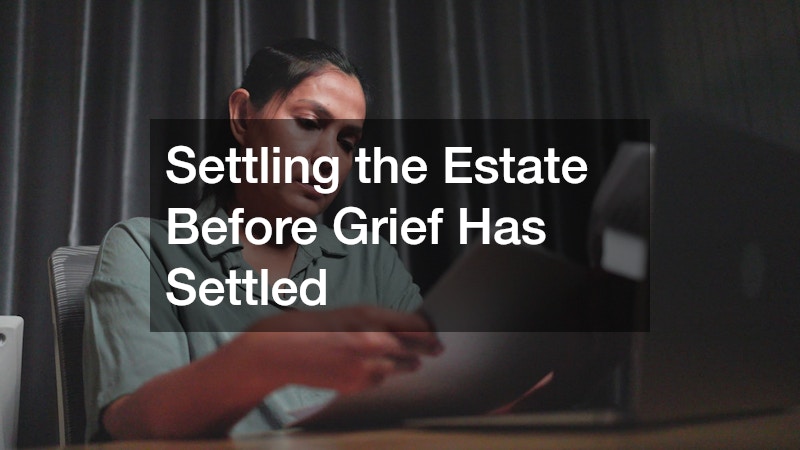
Estate administration has real deadlines — probate filings, tax elections, creditor notification windows — but these are narrower than most people assume. The mistake isn’t moving too slowly on legal requirements; it’s confusing administrative urgency with the urgency of permanent decisions.
Distributing personal property is where this gets complicated. Dividing furniture, jewelry, photographs, and keepsakes among family members within weeks of a death often creates rifts that last decades. People are grieving differently, and an object that feels meaningless to one sibling may carry enormous weight for another. Rushing that process turns objects into proxy battles for grief.
The formal elements of estate settlement — filing the will, opening probate, notifying financial institutions — should happen promptly. But the material decisions can almost always wait. Families who agree to a six-month moratorium on distributing personal property before any formal division typically report far less conflict.
Memorialization decisions carry similar weight. Choosing headstones, urns, or burial markers is something many families feel they must finalize immediately, but most decisions beyond the immediate funeral arrangements can be revisited or made more deliberately over weeks rather than hours.
- Set a 90-day minimum before making any irreversible decision about estate property distribution among family members.
- Document and photograph all significant personal items within 30 days to prevent disputes, even if distribution is delayed.
- Separate the legal administration timeline from the emotional one — consult a probate attorney to identify which deadlines are statutory and which are simply assumed.
Leaving a Job or Ending a Career Transition
The impulse to quit is strong after a significant loss. Work feels meaningless. The commute feels impossible. Colleagues don’t know what to say, and the silence is its own kind of weight. For some people, taking extended leave or even stepping away permanently is the right choice. For most, it’s a decision made at the worst possible moment with lasting financial consequences.
Grief-triggered career exits look different depending on the relationship and the person. Some people quit within weeks. Others stay but make sudden lateral moves — accepting lower-paying roles for the perceived emotional relief of a fresh environment — only to find that the grief followed them.
The financial math is worth running clearly. Leaving a job with a $75,000 salary and benefits, even temporarily, can set back retirement savings by three to five years when opportunity cost, vesting schedules, and insurance replacement costs are factored in. That doesn’t mean someone shouldn’t leave — but it means the calculation deserves more than an afternoon.
A more protective approach: request bereavement leave first, then use that window to determine whether extended family or medical leave under the Family and Medical Leave Act (FMLA) applies. FMLA provides up to 12 weeks of unpaid, job-protected leave for qualifying employees — enough time to make a less reactive decision about whether to stay or go.
Compare the options honestly. Staying with adjusted expectations versus leaving, taking leave versus resigning, requesting a temporary role change versus assuming nothing can change — each path has a different risk profile, and none of them should be settled before at least 60 days have passed.
Rushing Into or Out of a Relationship

Loss reshapes how people understand companionship. After losing a spouse or long-term partner, the loneliness can be acute enough to drive decisions that would have seemed implausible before. After losing a parent or child, some couples pull apart under the weight of grief managed differently.
Both directions — moving toward a new relationship too fast or abandoning an existing one without adequate support — carry high regret rates. Grief counselors frequently observe that the 12 to 18 months following a major loss represent the highest-risk window for relationship decisions of all kinds.
What makes this hard is that the feelings driving these decisions are completely real. The loneliness is real. The disconnection from a partner is real. The pull toward someone who represents comfort or escape is real. Recognizing those feelings as legitimate while also recognizing that they’re poor decision-making conditions is a difficult balance to hold.
- Before ending a long-term relationship in the 12 months following a major loss, attend a minimum of eight couples therapy sessions with a therapist who has specific experience in grief dynamics.
- If pursuing a new relationship, apply a 12-month rule before any major commitment — shared finances, cohabitation, or legal arrangements.
- Treat relationship decisions with the same deliberate pace recommended for financial ones: real urgency should be identifiable and specific, not just a feeling that something must change.
Giving Yourself Permission to Wait
The most consistent pattern across all of these decisions is that the cost of waiting is almost always lower than the cost of acting too soon. That’s not permission to avoid grief by avoiding decisions indefinitely — it’s recognition that most deadlines, when examined closely, have more flexibility than they appear to.
Before making any major decision in the first year after a loss, ask one question: what is the actual cost of waiting 90 days? If the answer is nothing concrete, then wait. If there is a real deadline, meet that specific obligation without treating it as a signal to resolve everything at once. Grief has its own pace. The best decisions tend to honor that rather than fight it.